
Tooth Extraction in Turkey
Dr. Emrah YEŞİLYURT
Medically Reviewed by Dr. Emrah Yeşilyurt Founder of Avangart Clinic. Dr. Yeşilyurt ensures all clinical content meets the highest standards of dental accuracy and patient safety.
At Avangart Dental Clinic in Istanbul, we know that tooth removal can feel stressful, especially when you are travelling from abroad. Our aim is to make the experience clear, safe, and as comfortable as possible from your first message to your final aftercare instructions.
We perform both simple extraction and surgical extraction, depending on the condition of the tooth. If the tooth is visible and easy to remove, treatment is usually quick. If it is broken, infected, impacted, or close to the bone, we plan the removal more carefully with an X-ray image or panoramic scan.
Your treatment is carried out under local anaesthesia, so you should not feel pain during the procedure. We also assist international patients who require more advanced care, such as multiple extractions or full mouth clearances prior to implants, dentures, or other dental procedures.
Before removing any tooth, we first determine whether it can be saved. If extraction is the safest option, we clearly explain why, what steps are involved, how to recover, and how much it costs.
Tooth Extraction Turkey Reviews
EXCELLENTTrustindex verifies that the original source of the review is Google. Service impeccable. Je suis venue pour des implants. La prise en charge a été rapide et la douleur pendant et après l’opération a été à peine ressentie. Clinique très professionnelle et chirurgien expert. Personnel très accueillant, en particulier la Directrice. Recommande à tous ceux qui sont à la recherche de professionnels pour régler des problèmes dentaires Suis venue finaliser la pose des implants et des couronnes. Résultat impécable!Posted on GoogleTrustindex verifies that the original source of the review is Google. I visited from England and had a positive experience. I went for a Hollywood Smile look and couldn’t be happier with them. The clinic was very aesthetic & clean, the staff were very attentive and supportive & I high recommend them.Posted on GoogleTrustindex verifies that the original source of the review is Google. İmplantlarımı ve zirkyonyumlarımı yaptırdım 2 sene önce iyiki yaptırmışım çok memnunum doktorum emrah hoca işinde çok iyi birisi tüm çalışanlara çok teşekkür ediyorum güler yüzlü anlayışları için gülşah hanıma ayriyetten teşekkür ederim 🌹Posted on GoogleTrustindex verifies that the original source of the review is Google. Çok güzel ve güveninirPosted on GoogleTrustindex verifies that the original source of the review is Google. Friendly and approachable staff, above all I haven’t experienced any pain what so ever, it does truly shows core professionalism. Coming from Wolverhampton, UK and made implant surgery with sinuslifting Gedi JafarPosted on GoogleTrustindex verifies that the original source of the review is Google. Ik Marco, hebt mijn gebit laten doen bij Avangart.. En ben door lieve mensen goed ontvangen en behandeld.. Kliniek zeer hygienisch en goede apparatuur.. Deze kliniek zo ik zeker aanraden om je laten behandelen..😁Posted on GoogleTrustindex verifies that the original source of the review is Google. I traveled from the U.S. and had Avantgart Clinic positively transform my smile in a manner that I wouldn’t have conceived as being possible. Dr. Egemen, a true master in his field, was patient, considerate, and communicative throughout the process and his assistant, Sevim, was a real joy to work with. Together, the two of them combined to make the overall experience much greater than I could have ever hoped for, and the end result is a smile that is on par with the most glamorous of Hollywood stars. I am extremely satisfied and would highly recommend Avangart Clinic to anyone looking to enhance their smile at a great price and of the highest quality.Posted on GoogleTrustindex verifies that the original source of the review is Google. Herkes mükemmel ıscılık mükemmel teşekkür edıyorumPosted on GoogleTrustindex verifies that the original source of the review is Google. Emrah bey‘in diş konusundaki tecrübesi, güler yüzü ve uzmanlığı nedeniyle diş tedavilerim için her seferinde Avusturya‘dan İstanbul’a gelmekteyim. Diş kliniği de son teknolojik donanıma sahip güven verici muayenehaneler içermekte.Posted on GoogleTrustindex verifies that the original source of the review is Google. Güler yüzlü ekip, temiz ve modern bir klinik. Tedavi sürecim baştan sona çok profesyoneldi. Gönül rahatlığıyla tavsiye ederim.Verified by TrustindexTrustindex verified badge is the Universal Symbol of Trust. Only the greatest companies can get the verified badge who has a review score above 4.5, based on customer reviews over the past 12 months. Read more
Avangart is Authorised by the Turkish Ministry of Health for International Dental Tourism.
Your health is our priority. Avangart Oral and Dental Health Polyclinic is fully authorized by the Ministry of Health to provide international health tourism services. This means our polyclinic has been independently verified to meet the high standards of safety, hygiene, and medical expertise required to serve the global community.
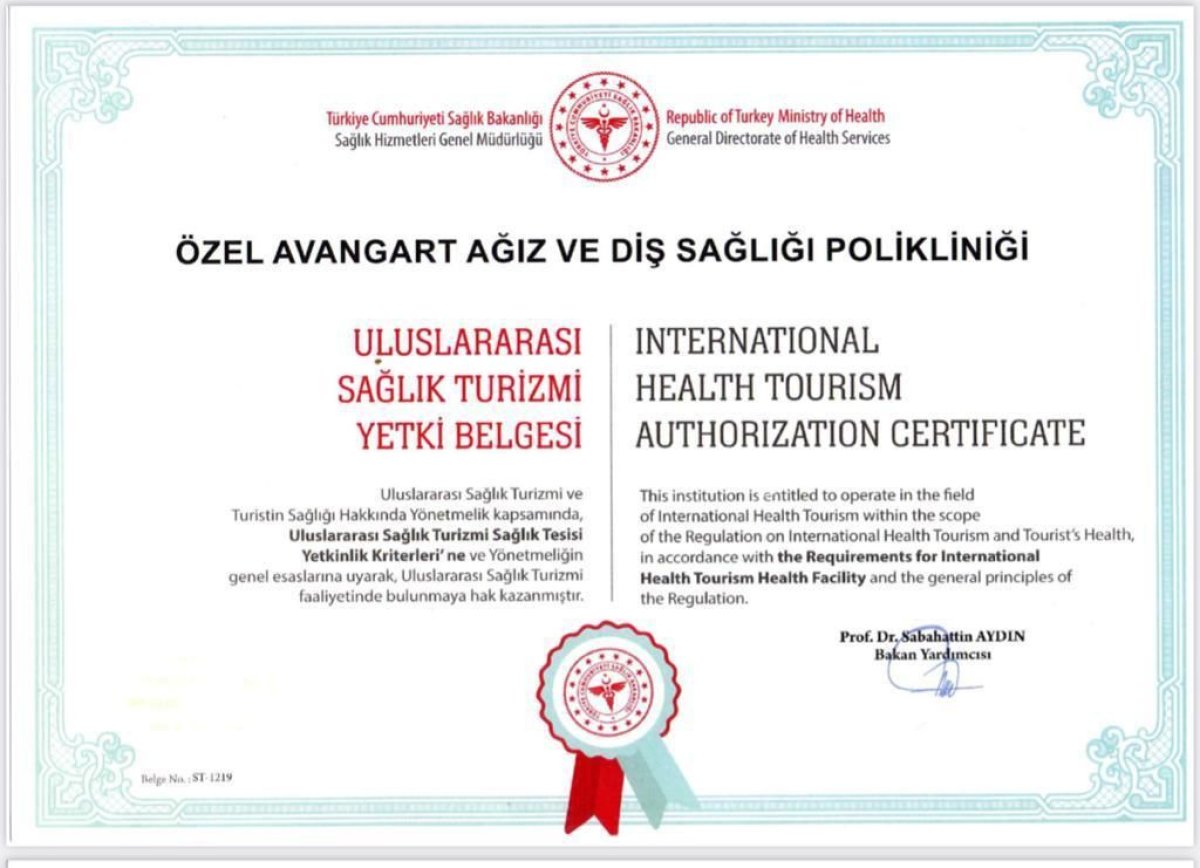
Table of Contents
The Reasons Behind a Tooth Extraction
A tooth is only removed when keeping it would cause more harm than benefit. Before extraction, we always check whether the tooth can be saved with a filling, crown, or root canal. If the damage is too serious, removal may be the safer choice.
Common Reasons Include:
- Severe decay. When decay goes deep into the tooth and leaves too little healthy structure to repair.
- Infection or abscess. If the infection keeps returning or spreads around the root.
- Advanced gum disease. When bone support is lost, the tooth becomes loose.
- Broken root or trauma. When a cracked or fractured tooth cannot be restored.
- Crowded teeth. Sometimes, teeth are removed to create space before orthodontic treatment.
- Impacted wisdom teeth. When third molars cause pain, infection, or pressure on nearby teeth.
Some patients also need a full mouth extraction when most teeth are badly damaged, loose, or infected. This may be part of a larger plan where patients have all teeth removed before getting dental implants for replacement, such as All-on-4 implants or All-on-6 implants.
For many people, these implant systems can be a fixed dentures alternative, especially when removable dentures would not feel stable or comfortable.
Cost of Tooth Extraction in Turkey.
The cost of tooth extraction in Turkey is usually much lower than in the UK or the US. The final price depends on the tooth position, root shape, infection level, and whether you need a simple or surgical extraction.
| Treatment type | Typical Turkey price range | Typical UK/US private price |
|---|---|---|
| Simple tooth extraction | £40–£90 | £150–£350 / $200–$500 |
| Surgical tooth extraction | £90–£180 | £300–£800 / $500–$1,000+ |
| Wisdom tooth removal | £120–£250 | £350–£1,000+ / $600–$1,500+ |
| Molar extraction | £80–£200 | £250–£700 / $400–$1,000+ |
The molar extraction cost is often higher than that of a front tooth because molars have larger roots and sit deeper in the jaw. A broken, infected, or impacted molar may also need more time and careful planning.
Turkey is more affordable because of currency exchange, lower clinic running costs, and lower dental lab costs. It does not mean low-quality or “rushed” care.
We understand that many patients search for cheap tooth extraction, but safety should always come first. Before treatment, we check your X-ray, explain the cost of tooth removal, and confirm the full price clearly, so you know what to expect before we begin.
Book Your FREE Consultation For Dental Treatments!
Types of Tooth Extractions
There are two main ways to remove a tooth. We choose the method after checking your tooth, your X-ray result, and how difficult the removal may be.
Simple Extraction
A simple extraction is used when the tooth is easy to see in the mouth (front teeth, premolars, loose teeth, or fully erupted molars). After numbing the area, the dentist gently loosens the tooth and removes it with dental forceps.
This is usually the quicker option. It may be used for a loose tooth, a badly decayed tooth, or a tooth that cannot be repaired. For patients comparing tooth extraction in Turkey, a simple extraction usually costs less than a surgical extraction because it is less complex and takes less time.
Surgical Extraction
A surgical extraction is needed when the tooth is not easy to remove. This can happen when a tooth is broken at the gum line, trapped under the gum, impacted, or has curved, deep, or unusually shaped roots.
In these cases, the dentist may make a small opening in the gum and remove the tooth carefully in sections. If you feel very nervous, or if the case is more complex, we can also discuss sedation for extractions after reviewing your medical history.
Surgical removal usually takes more time, skill, and careful planning. For this reason, the total extraction costs may be higher than a simple tooth removal.
Wisdom Teeth Removal
Wisdom teeth, also called third molars, are the last teeth at the back of the mouth. They usually appear between ages 17 and 25, but they do not always have enough space to grow properly.
Removal may be needed if a wisdom tooth is impacted, infected, damaged by decay, or pushing against the next tooth. Some patients also feel jaw pain, swelling, bad taste, or pressure when the tooth is only partly through the gum.
Many UK and US patients choose wisdom teeth removal in Turkey because private treatment at home can be expensive, and appointments may take a long time to arrange. Still, we never treat it as just a cheap tooth extraction. Our goal is safe, planned care at a fair price.
Before removal, we check your X-ray, root position, nerve distance, and general health. This helps us follow proper extraction safety standards and explain the cost of tooth extraction clearly before treatment begins.
The Procedure
First, we examine your mouth and take a 3D Panorex X-ray. This lets us see the roots, the surrounding bone, and whether the tooth is close to a nerve or hidden under the gum.
If the tooth is being extracted as part of a larger treatment plan, such as implants, dentures, or dental bridges, we explain the entire procedure first. For patients who need full mouth tooth extraction, each tooth is planned carefully so the process stays controlled and safe.
1. Numbing or Sedation
In most cases, we use local anaesthesia to fully numb the area around the tooth. If you feel very anxious or if the extraction is more complex, we may also talk to you about sedation after reviewing your medical history.
2. Tooth Removal
For a simple extraction, the dentist gently loosens the tooth with an elevator before removing it with forceps. A small incision in the gum can be used for a surgical extraction, and the tooth can be removed in sections.
3. Cleaning the Socket
After the tooth is removed, the socket is cleaned carefully. If needed, stitches are placed to help the gum heal.
4. Gauze and Blood Clot
We place gauze over the socket to control bleeding and support blood clot formation. This clot is very important because it protects the bone and helps healing begin.
Book Your FREE Consultation For Dental Treatments!
How to Take Care During the Recovery Phase
The first goal following a tooth extraction is to protect the blood clot inside the socket. This clot promotes gum and bone healing. If it moves too early, it can cause a painful condition known as dry socket (Alveolar Osteitis).
For the first 24 hours, rest as much as you can. Keep the gauze in place for the time your dentist recommends, and bite on it gently to control bleeding. Do not rinse, spit hard, or touch the area with your tongue or fingers.
For food, choose a soft diet for the first 1–2 days. Good options include yoghurt, soup that is not hot, mashed potatoes, smoothies (taken with a spoon instead of a straw), soft eggs, and pureed vegetables. Chew on the opposite side of your mouth.
Avoid these during early healing:
- Straws, because suction can remove the clot
- Smoking and alcohol
- Hot drinks and hot foods
- Hard, crunchy, or spicy foods
- Heavy exercise for a few days
To reduce swelling, place an ice pack on the outside of your face for 10 minutes, then take a break. You can repeat this during the first few hours after treatment.
After 24 hours, you may gently rinse with warm salt water. Brush your teeth as normal, but avoid the extraction site until it feels safe. Take painkillers or antibiotics only as instructed by your dentist.
The Risks Involved With a Tooth Extraction
Tooth extraction is very common, but it is still a small surgical procedure. We want you to understand the possible risks clearly, so you know what is normal and when to contact us.
Dry Socket
After the tooth is extracted, a blood clot forms within the empty socket. This clot protects the alveolar bone while the area heals.
If the clot comes out too early, the bone can become exposed. This is known as a dry socket. It can cause severe pain, a bad taste, or an unpleasant smell.
To lower this risk, we place gauze after treatment and explain the main rules clearly: no smoking, no straws, no hard rinsing, and no hot drinks in the early healing stage.
Bleeding and Infection
Light bleeding is normal on the first day. Infection is less common, but it can happen, especially if the tooth already had an abscess or gum disease before extraction.
We reduce this risk by checking your X-ray, reviewing your medical history, cleaning the socket carefully, and prescribing medicine only when it is needed.
Nearby Tooth or Nerve Irritation
With difficult extractions, nearby teeth, old fillings, crowns, or nerves may be affected. This risk is higher with impacted wisdom teeth or deep molars close to a nerve.
That is why we plan complex cases with detailed imaging and careful technique. If you are travelling to Turkey from abroad, our team also gives 24/7 post-op WhatsApp support, so you can contact us if you feel unusual pain, swelling, bleeding, fever, or numbness.
Your surgery is only as good as the hands performing it. Our clinical team is led by Dr. Emrah Yeşilyurt, the innovator behind Toronto Hybrid Technology and Dr. Egemen Aras. Together, they bring over two decades of combined experience in Turkish and international dentistry.
Dr. Emrah YEŞİLYURT | Maxillofacial Surgeons & Prosthodontists
Start Creating Your Treatment Plan!
You can contact us by filling out the pre-request form.
FAQs
Turkey can be a good option if you need safe tooth removal at a lower cost than private treatment in the UK, US, or Europe. You can also combine your consultation, X-ray, extraction, and recovery guidance in one planned visit.
For international patients, the main benefit is clear planning. Before treatment, we check your tooth with imaging, explain whether it needs a simple or surgical extraction, and confirm the cost before we start.
You may be a good candidate if your tooth cannot be saved with a filling, crown, or root canal. This can happen with deep decay, repeated infection, severe gum disease, a broken root, or an impacted wisdom tooth.
Some patients also need extraction before implants, dentures, braces, or full-mouth treatment. We always check your medical history, X-ray, and oral health first to make sure extraction is the safest choice.
Yes, in some cases, a tooth can be removed and an implant placed during the same visit. This is called immediate implant placement, and it may be possible when the bone is healthy, infection is controlled, and the area is stable enough.
It is not suitable for every patient. If you have a severe infection, significant bone loss, or need a more complex extraction, we may recommend letting the area heal first before placing the implant.
No. A wisdom tooth does not need to be removed if it has enough space, grows in the right position, stays clean, and does not harm the tooth next to it.
Removal may be needed if it is impacted, infected, painful, decayed, or pushing against nearby teeth. We check the X-ray first, then explain whether keeping it or removing it is the safer choice.
Feeling nervous is completely normal, especially if you're travelling for treatment. Before we begin, we explain each step, numb the area with local anaesthesia, and proceed calmly so you feel informed, comfortable, and in control.
If your anxiety is high, we can discuss sedation options after reviewing your medical history. Many patients feel better once they understand that they should not feel pain during the procedure.
Often, yes, but it depends on the condition and how well it is managed. Patients with diabetes, high blood pressure, heart conditions, bleeding problems, or those using blood thinners need a careful medical review before extraction.
Please tell us about your health history and medications before treatment. This helps us plan the safest approach and decide whether we need extra precautions, medical clearance, or changes to timing.
Antibiotics are not required for all tooth extractions. We only recommend them when there is a compelling reason, such as an active infection, an increased risk of infection, or certain medical conditions.
Please do not take antibiotics on your own prior to treatment. Our dentist will examine your tooth, X-rays, and medical history to determine whether antibiotics are required before or after the extraction.
A tooth may be extracted to make room for braces or clear aligners. This may be required when teeth are crowded, and there is insufficient space to move them into a healthy position.
Extraction is not the first option in all orthodontic cases. We only recommend it when it contributes to a better bite, cleaner tooth alignment, and a more stable long-term outcome.
The first 24 hours are mainly about protecting the blood clot and controlling bleeding. After having your wisdom teeth removed, mild pain, swelling, and stiffness in the jaw are normal.
Swelling typically peaks around 48 hours, after which it gradually improves. Most patients feel better in a few days, but deeper gum and bone healing takes longer. Follow your aftercare instructions, eat soft foods, avoid smoking and straws, and contact us if the pain worsens instead of improving.
References
Daly BJ, Sharif MO, Jones K, Worthington HV, Beattie A. Local interventions for the management of alveolar osteitis (dry socket). Cochrane Database Syst Rev. 2022 Sep 26;9(9):CD006968. doi: 10.1002/14651858.CD006968.pub3. PMID: 36156769; PMCID: PMC9511819.