
Why Are My Gums White Around My Teeth? Causes, Risks & Treatment Guide

Dr. Emrah YEŞİLYURT
Dr. Emrah Yeşilyurt is the Founder of Avangart Clinic. He combines advanced dental expertise with a genuine commitment to helping patients feel comfortable and informed about their oral health journey.

If you have noticed white gums around your teeth, it is natural to feel concerned. Healthy gums are usually pink, so when the colour starts to look pale or patchy, it is natural to ask, why are my gums white?
In many cases, white gums are caused by something relatively minor, such as irritation, dryness, or a build-up of plaque along the gumline. Sometimes the change settles once the trigger is removed and your oral care improves. However, white gums are not always easy to interpret, so if the colour change does not fade, it should not be ignored.
What matters most is the full picture. If your gums look white, or the area feels sore, tender, or different from usual, it is best to have it checked rather than guess the cause yourself.
At Avangart Dental Clinic in Turkey, we always tell patients the same thing: white gums are not always serious, but they are always worth understanding properly. In some people, they may reflect a local gum issue. In others, they can be a sign of a wider health problem, including anaemia, and in rare cases, they may point to a more serious condition such as oral cancer.
If the colour change does not begin to improve within several days or keeps returning, a professional examination is the safest next step. Our role is not just to look at the colour of the gums, but to find out why it has changed and whether any treatment is needed.
Satisfied Patient Reviews
EXCELLENTTrustindex verifies that the original source of the review is Google. Service impeccable. Je suis venue pour des implants. La prise en charge a été rapide et la douleur pendant et après l’opération a été à peine ressentie. Clinique très professionnelle et chirurgien expert. Personnel très accueillant, en particulier la Directrice. Recommande à tous ceux qui sont à la recherche de professionnels pour régler des problèmes dentaires Suis venue finaliser la pose des implants et des couronnes. Résultat impécable!Posted onTrustindex verifies that the original source of the review is Google. I visited from England and had a positive experience. I went for a Hollywood Smile look and couldn’t be happier with them. The clinic was very aesthetic & clean, the staff were very attentive and supportive & I high recommend them.Posted onTrustindex verifies that the original source of the review is Google. İmplantlarımı ve zirkyonyumlarımı yaptırdım 2 sene önce iyiki yaptırmışım çok memnunum doktorum emrah hoca işinde çok iyi birisi tüm çalışanlara çok teşekkür ediyorum güler yüzlü anlayışları için gülşah hanıma ayriyetten teşekkür ederim 🌹Posted onTrustindex verifies that the original source of the review is Google. Çok güzel ve güveninirPosted onTrustindex verifies that the original source of the review is Google. Friendly and approachable staff, above all I haven’t experienced any pain what so ever, it does truly shows core professionalism. Coming from Wolverhampton, UK and made implant surgery with sinuslifting Gedi JafarPosted onTrustindex verifies that the original source of the review is Google. Ik Marco, hebt mijn gebit laten doen bij Avangart.. En ben door lieve mensen goed ontvangen en behandeld.. Kliniek zeer hygienisch en goede apparatuur.. Deze kliniek zo ik zeker aanraden om je laten behandelen..😁Posted onTrustindex verifies that the original source of the review is Google. I traveled from the U.S. and had Avantgart Clinic positively transform my smile in a manner that I wouldn’t have conceived as being possible. Dr. Egemen, a true master in his field, was patient, considerate, and communicative throughout the process and his assistant, Sevim, was a real joy to work with. Together, the two of them combined to make the overall experience much greater than I could have ever hoped for, and the end result is a smile that is on par with the most glamorous of Hollywood stars. I am extremely satisfied and would highly recommend Avangart Clinic to anyone looking to enhance their smile at a great price and of the highest quality.Posted onTrustindex verifies that the original source of the review is Google. Herkes mükemmel ıscılık mükemmel teşekkür edıyorumPosted onTrustindex verifies that the original source of the review is Google. Emrah bey‘in diş konusundaki tecrübesi, güler yüzü ve uzmanlığı nedeniyle diş tedavilerim için her seferinde Avusturya‘dan İstanbul’a gelmekteyim. Diş kliniği de son teknolojik donanıma sahip güven verici muayenehaneler içermekte.Posted onTrustindex verifies that the original source of the review is Google. Güler yüzlü ekip, temiz ve modern bir klinik. Tedavi sürecim baştan sona çok profesyoneldi. Gönül rahatlığıyla tavsiye ederim.Verified by TrustindexTrustindex verified badge is the Universal Symbol of Trust. Only the greatest companies can get the verified badge who has a review score above 4.5, based on customer reviews over the past 12 months. Read more
Identifying the Cause: A Symptom Comparison Table
| Appearance | Likely Cause | Urgency Level |
|---|---|---|
| Thin white film or mild pale change that appeared after brushing, using whitening products, or a strong mouthwash | Surface irritation or tissue peeling | Low to moderate — monitor it closely, especially if it settles within a few days |
| Small round white spot with a sore centre | Canker sore or local irritation | Moderate — worth checking if painful or not improving |
| Creamy white coating that may wipe away and leave a red, sore area underneath | Oral thrush or another fungal irritation | Moderate — book an appointment, especially if it spreads |
| Thick white patch that does not rub off | Leukoplakia or another change that needs clinical assessment | High — arrange a dental review promptly |
| Pale gums with a more general washed-out look rather than a defined patch | Reduced blood supply, anaemia, or another systemic issue | Moderate to high — especially if you also feel tired or unwell |
| Sore, inflamed gumline with plaque build-up and white swollen gums in places | Gum inflammation or early infection | Moderate — a professional cleaning and gum assessment are usually needed |
| Localised white area with tenderness, swelling, bad taste, or discharge | Possible white gum infection | High — this should be assessed promptly |
| Patchy or persistent change where patients notice their gums turning white without a clear reason | Several possible causes, from irritation to tissue changes that need diagnosis | Moderate to high — if it lasts more than around two weeks, do not leave it unchecked |
In our experience, colour alone rarely tells the whole story. Details such as whether the area wipes away, feels rough, looks raised, or causes soreness often matter more than the colour alone.
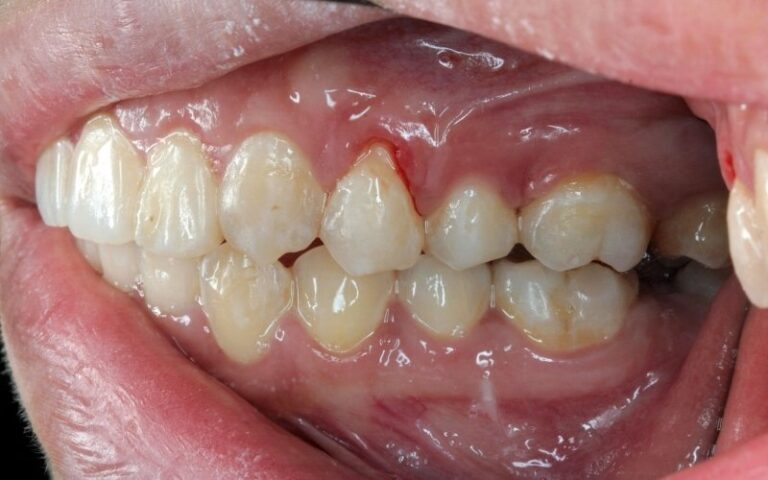
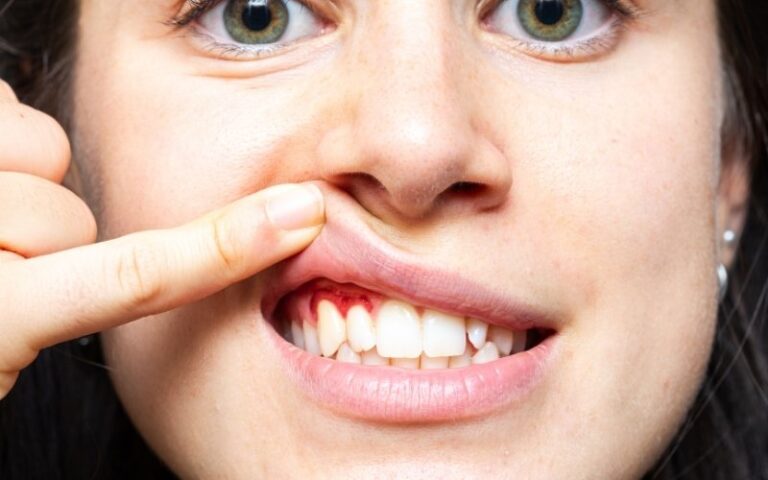
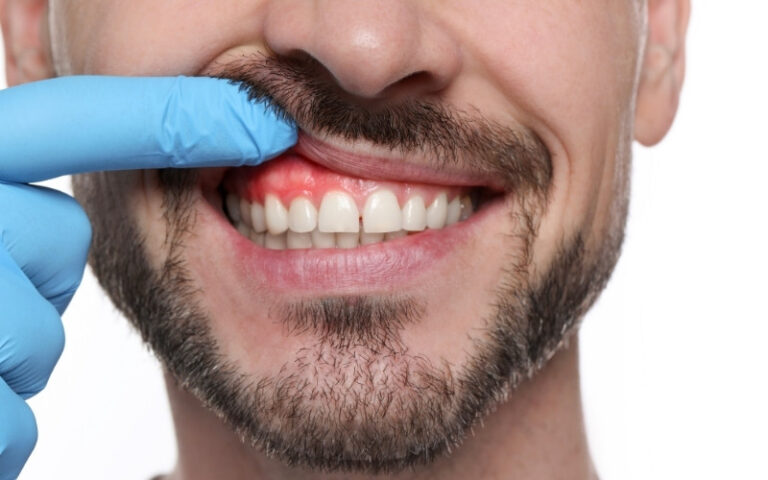
White spots on gums pictures
Here are a few examples of what white spots on the gums can look like. If yours don’t go away or feel sore, it’s best to get them checked by a dentist.
Common Medical Causes for White Gums
Not every white area on the gums points to the same problem. We look at whether the patch is fixed or wipeable, whether the tissue feels sore or rough, and whether the change appears to be coming from infection, irritation, or a deeper tissue change.
Leukoplakia: The Thick White Patch That Won’t Budge
Leukoplakia is one of the conditions we consider when a white patch stays in the same area and does not clear on its own. These lesions are typically non-removable, which means they do not scrape off with a toothbrush, gauze, or gentle wiping, and that makes them different from a simple surface coating or fungal plaque. If a white patch in the mouth does not go away, it should always be checked by a dental professional, and in some cases, a biopsy may be recommended to look for abnormal cells.
Leukoplakia is often associated with long-term irritation, especially in people who smoke or use tobacco products, and the white appearance may be caused by hyperkeratosis, which is a thickening of the surface tissue. Most cases are not cancer, but some can show precancerous change, and a small proportion may progress to mouth cancer over time. That is why a persistent white patch on the gum should never be dismissed as “just irritation” without an examination.
Oral Candidiasis (Thrush): The Fungal Connection
Oral candidiasis, often called oral thrush, is a fungal infection usually caused by Candida albicans. It often has a soft, creamy, cottage cheese consistency, and that appearance gives us an important clue during an oral exam.
The key difference is that thrush can usually be wiped away, at least partly. When it comes off, it often leaves a red, sore area underneath, and that raw surface may bleed slightly. This is very different from leukoplakia, which stays attached to the tissue.
Gingivitis & Chemical Irritation
Classic gingivitis starts with plaque biofilm along the gumline and creates an inflammatory response, so the gums often look red, puffy, and prone to bleeding. But in some patients, the surface can also look pale or whitish where the tissue has been irritated or damaged.
White-looking gums can also develop after chemical irritation from strong whitening gels, peroxide-based products, or certain oral care ingredients. In these cases, the top layer may peel away as sloughing tissue, which can look like a thin white film or soft, dead skin. Some oral care ingredients, including sodium lauryl sulphate, chlorhexidine, and certain essential oils, have been linked to surface peeling in the mouth. Unlike a true fixed white lesion, this kind of irritated surface layer can usually be wiped away more easily during examination.
The Hidden Link: When White Gums Indicate Tissue Issues
Sometimes, the white appearance is not caused by a film, patch, or infection at all. In some patients, the real issue is thin gum tissue or gingival recession, where the gum has pulled back, and the area around the tooth starts to look lighter, flatter, or more washed out than the surrounding tissue. This is especially common when the keratinized tissue (the firmer, more protective gum tissue around the teeth) is limited, delicate, or uneven around the teeth.
We often see this in patients who say the gum does not just look pale, but also looks “too high”, “too thin”, or irregular in shape. In these cases, the whiteness may come from tissue thinning that makes the underlying root surface or bone contour more visible through the gumline. It is not always painful, but it can affect both comfort and gingival aesthetics, especially when the smile line exposes more of the gums.
This is where treatment needs to be tailored specifically. Some patients benefit more from soft tissue grafting to improve coverage and strengthen the gumline, whereas others may benefit from Gum Contouring to reshape uneven tissue and create a healthier, more balanced appearance. When the gum display is irregular, our aim is not only to improve the look of the smile, but also to protect long-term periodontal health and reduce the risk of further tissue loss.
If the pale or white area around your teeth seems tied to gum shape, gum thinning, or a receding gumline, it is worth having it assessed properly rather than assuming it is only a surface problem. For patients who want to improve both protection and appearance, our Gum Contouring treatments in Istanbul may be a good option.
Systemic Health: Anemia and Vitamin Deficiencies
Sometimes, pale gums are not really a gum problem first. They can be a sign that your body is not carrying enough oxygen-rich blood to the tissues. That is why anaemia is one of the health conditions we consider when gums lose their usual pink colour and start to look unusually pale or blanched.
Iron deficiency and vitamin B12 deficiency are two of the most common reasons for this. Both can affect healthy red blood cell production, and when fewer working red blood cells reach the gum tissue, the colour can fade. In simple terms, the gums may look paler because they are not receiving the usual level of oxygen-rich blood.
This kind of colour change is often more widespread than a single white patch. Instead of one isolated white area, the gums may look evenly pale across several teeth, and some patients also notice tiredness, dizziness, shortness of breath, headaches, or skin that looks paler than usual. When those signs appear together, the cause may sit beyond the mouth.
At Avangart Dental Clinic, we pay attention to these patterns because not every case can be solved with cleaning or local treatment. If the gums look unusually pale and there is no obvious sign of a surface change or local irritation in the mouth, we may recommend blood tests alongside your dental examination. That way, the underlying issue is not missed while the visible symptom is being assessed.
Healthy gums depend on more than brushing alone. They can reflect changes in circulation, nutrition, and general health, which is why persistent pale gums should be assessed properly rather than seen as only a cosmetic issue.
When is it an Emergency? (Red Flags)
Most cases of white or pale gums are not a same-day emergency, but some signs should never be watched for too long. If any of the following apply, we recommend arranging an urgent dental or medical assessment rather than waiting to see if it settles on its own.
Red flags to act on promptly:
- Persistent bleeding from the gums or mouth that is unusual or keeps returning
- A lump, swelling, or thickened area on the gums, inside the mouth, or in the neck
- A white or red patch that does not improve or disappear
- Any sore, ulcer, or patch that has not healed within 14 days should be booked in for review, and if it lasts beyond 3 weeks, it should be treated as more urgent because that falls within recognised mouth cancer warning criteria.
- Difficulty swallowing, painful swallowing, or the feeling that something is stuck in the throat
- Ongoing mouth pain, numbness, or a change in how the tongue or jaw moves
- Loose teeth without an obvious reason, especially when they occur alongside a persistent white or red lesion on the gums
A simple rule we share with patients is this: if the area is getting worse, feels unusual, or has not clearly improved within two weeks, do not leave it to chance. It is especially important to get checked promptly if you are having trouble swallowing, ongoing bleeding, a sore or patch that is not healing, or any new lump in or around the mouth.

Professional Treatments at Avangart Clinic
At Avangart Dental Clinic, we know that seeing white or pale gums can be unsettling. Most patients come in wanting one simple answer, but the right treatment depends on why the gums look that way in the first place.
That is why we start with a careful examination rather than jumping straight to treatment. We look at the colour, texture, position of the gumline, and the health of the surrounding teeth and tissue, so we can tell whether the issue is inflammatory, structural, or something that needs further investigation.
Our treatment approach may include:
Assessment of suspicious white patches
If an area looks unusual and does not behave like simple irritation, we may recommend a biopsy or refer you for further testing. The aim is to rule out anything serious as early as possible.
Professional cleaning for irritated or inflamed gums
If the problem is linked to plaque build-up and gum inflammation, we usually begin with a deep professional clean and a clear home-care plan. This often helps calm the tissue and gives the gums a better chance to recover.
Treatment for gum recession and thin tissue
Sometimes the gum looks white because it has become thin, uneven, or pulled back. In these cases, we assess the gumline carefully and discuss the best way to restore support and improve the appearance.
Aesthetic gumline correction
For patients whose concern is both medical and cosmetic, we may recommend reshaping the gumline to create a more even, healthier look. This can be especially helpful when the tissue frame around the teeth looks irregular.
We also take into account any previous dental work. If the gum issue is affecting the area around Dental Implants or Dental Veneers, we assess the tissue very carefully to protect both the health of the gums and the overall appearance of the final result. And if you have had a failed gum graft in the past, we look closely at tissue quality, healing history, and whether a second-stage correction is realistic and worthwhile.
Our goal is always the same: to find the real cause, explain it clearly, and guide you towards the treatment that makes the most sense for your mouth.
FAQs
Yes, they can — but it depends on the cause. If the change is linked to short-term irritation, dryness, or a reaction to a product, the gums may return to their normal colour once the trigger is removed and the tissue has had time to settle.
What matters is how long it lasts and whether anything else comes with it. If the whiteness stays, keeps coming back, or appears with soreness, swelling, or a change in texture, it is better to have it examined rather than wait and hope it clears on its own.
The safest answer is this: do not try to scrub it off aggressively at home until you know what it is. A white film can come from surface irritation, peeling tissue, fungal overgrowth, or residue left behind by a product, and each one needs a different response.
A good first step is to stop any new or strong oral products you have been using, keep your routine gentle, and use a soft toothbrush. If the film wipes away easily but leaves the area red or sore, or if it returns quickly, book an assessment so we can identify the cause properly and guide the right treatment.
Stress does not usually turn healthy gums white by itself, but it can contribute indirectly. For example, stress can lead to clenching, dry mouth, poor sleep, reduced appetite, or a drop in oral care, all of which can make gum problems more likely or make mouth irritation more noticeable.
We also see patients under stress who develop sore areas in the mouth more easily or become more aware of changes they might otherwise ignore.
It can be. Whitening gels contain peroxide, and if some of the gel touches the gum tissue, the area can look temporarily blanched or pale afterwards. This is usually short-lived and settles as the tissue recovers, but if the whiteness is painful, spreading, or still there after a few days, it is worth having it checked.
Salt water can help soothe irritated gums and keep the area cleaner, especially when the tissue feels tender or inflamed. It is a supportive measure, not a cure, so it may ease discomfort, but it will not solve the underlying cause if the white area is due to infection, a persistent lesion, or tissue loss.
If you want to try it at home, mix about half a teaspoon of salt into a glass of warm water, rinse gently, and then spit it out.
There is no single timeline because it depends on the cause. Mild irritation may settle within a few days, while healing after gum treatment or surgery often takes longer and depends on how much the tissue has been affected. If the area is not clearly improving within about two weeks, or it lasts beyond that without a clear reason, it should be examined.
If you are wondering whether gum grafting is still an option, the answer depends on the condition of the tissue and the long-term outlook for the tooth. What matters most is whether there is enough healthy support around the tooth, how advanced the recession is, whether the gums are still stable enough to treat, and whether the underlying cause has been brought under control first.