
What Are The Different Types Of Dentures?

Dr. Emrah YEŞİLYURT
Dr. Emrah Yeşilyurt is the Founder of Avangart Clinic. He combines advanced dental expertise with a genuine commitment to helping patients feel comfortable and informed about their oral health journey.
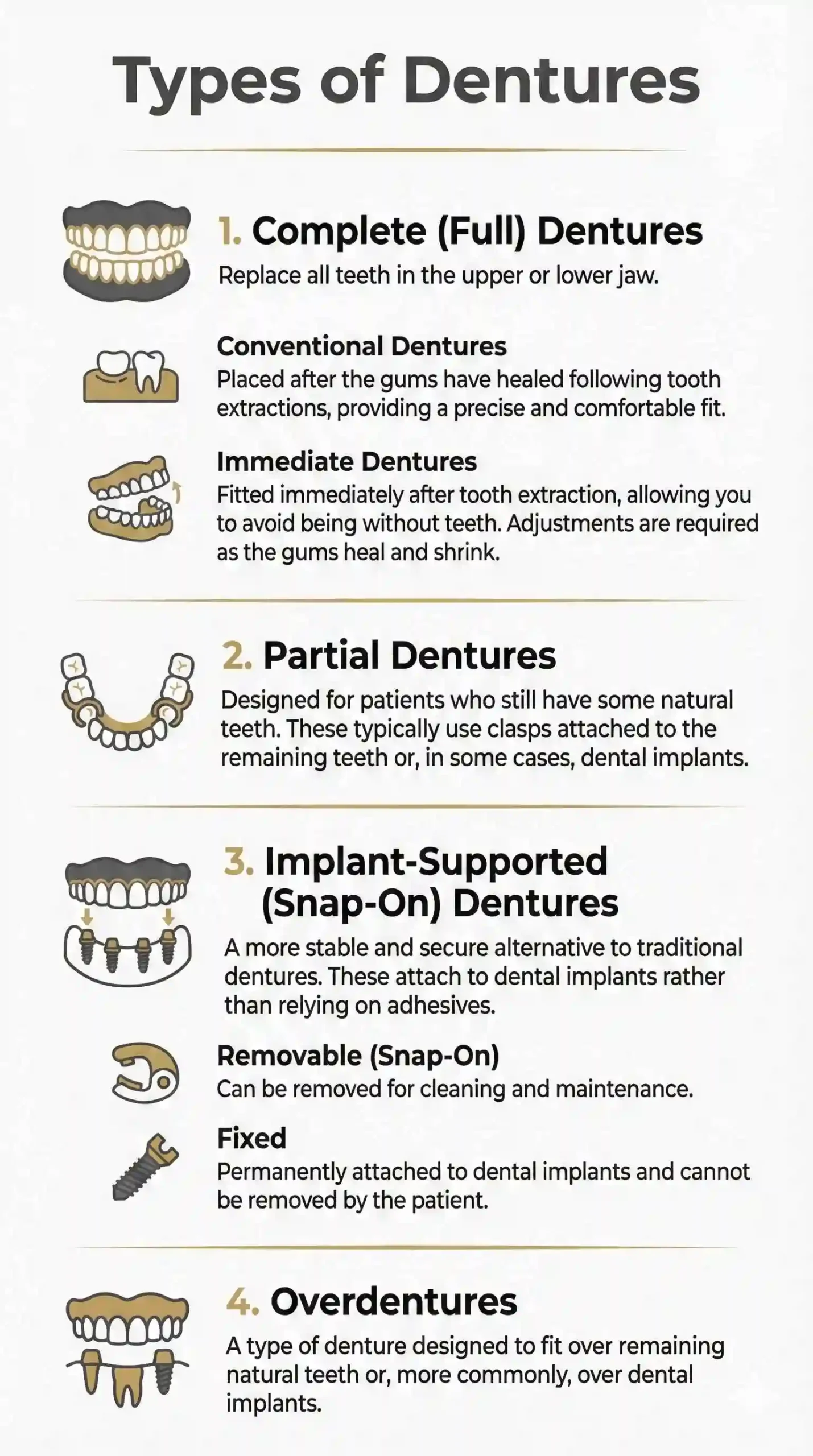
Types of Dentures: A Complete Guide to Options
Missing teeth can affect how you eat, speak, and smile. Dentures are removable oral appliances that replace those teeth and help you feel like yourself again. You can choose full dentures, partial dentures, or implant-supported dentures, and each choice serves different goals for comfort, stability, and appearance.
Dentures do more than close a gap in your smile. A well-fitted set can improve chewing and speech, support your cheeks and lips to reduce facial sagging, and encourage better oral health when you keep up a good care routine.
Some dentures snap onto implants and feel very stable, while others are removable and use suction, clasps, or small attachments to stick to the gums. Names of dentures can also vary between clinics, so it is a good idea to ask your dentist to explain exactly how each type works, what the pros and cons are for you, and even practical questions like “Can you chew gum with dentures?” This guide walks through the major types of denture teeth in clear language and provides an idea of typical costs to help set expectations.
Whether you are comparing denture options for one or more teeth, this overview will help you make an informed decision. We will discuss key denture variants, who they best suit, and how the process typically unfolds from start to finish. Whether you are considering care close to home or exploring dental work in Turkey, the same principles apply and will help you plan with confidence.
What Are the Different Kinds of Dentures You Can Get?
Most people who lose one or more teeth want to find a solution as soon as possible so that their lives can return to normal. The best choice depends on many things, like the teeth on each side of the gap and the teeth that bite against it. Oral health, age, daily habits, and budget also matter, as do your goals for speech and chewing, so your plan for tooth replacement should reflect all of that.
There are two major options: fixed and removable. Fixed options are cemented to teeth and stay in place. Removable options can be removed for cleaning and can be either full or partial dentures.
Artificial teeth can be attached to healthy teeth using small connectors or sit on dental implants in the jaw. Your dentist can also combine methods, for example, placing a crown on an implant and using it to anchor a partial denture.
If you are comparing what dentures are available, ask for a clear explanation of how each one would work in your mouth. Talk through fit, care, adjustment visits, and total cost so expectations are realistic. The same questions help determine whether you plan treatment close to home or look into dentures in Turkey for care.
Full Dentures:
Full dentures replace all teeth in the upper or lower jaw, and you can remove them for cleaning. They have a pink acrylic base that rests over your gums for a natural look.
This denture type suits people who need a complete smile after many tooth extractions. Typical costs average $1,968, with a range of $1,520 to $3,648, and vary by quality and location.
Partial Dentures:
Partial dentures are designed to replace only a few missing teeth, making them ideal for people who are missing a quarter or half of their teeth. They help you replace just your missing teeth to give you a full smile. They are removable and usually sit on an acrylic framework that fits your gums. Small clasps attach to nearby teeth, which helps stop shifting and keeps your bite more stable.
This type of false teeth can be a budget-friendly step compared with bridges or implants. Prices vary by material and design, so plan a chat with your dentist about options. Resin partials average about $1,738, and can range from $1,333 to $3,283, while metal partials average about $2,229, with a range from $1,728 to $4,203.
Traditional Dentures Explained:
Traditional dentures are one of the most common types of dentures available; they are the classic removable choice that rest on your gums and stay put with natural suction. They do not use metal frames or dental implants, which keeps the design simple and easy to maintain for most people.
Costs usually average about $1,968, with a typical range from $1,520 to $3,648 depending on your location and the quality of finish you choose.
Immediate Dentures:
Immediate dentures let you leave the clinic after a tooth extraction with a complete smile, the very same day. Many dentists call them temporary or interim because they are designed for short-term use while your gums heal. They are one of the practical artificial teeth types for people who don’t want to leave a tooth gap empty for too long.
Your dentist measures your mouth and makes a model ahead of time so the denture is ready at your removal appointment. However, as the bone and gums change shape, you will likely need relines or a replacement once healing finishes, which can take up to 12 months. Typical pricing for immediate dentures in the U.S. averages about $2,178, with a common range from $1,707 to $3,540 depending on location and quality.
Transitional Dentures:
Transitional dentures are a broader term for any temporary denture used between steps of treatment. It can be a partial fitted right after some extractions or a short-term denture used while more teeth are removed in stages. It completes your smile until your final tooth replacement is ready.
They are related to immediate dentures, but are not exactly the same. Every immediate denture is transitional because it is temporary for healing. Not every transitional denture is immediate because some are fitted days or weeks later or used during staged treatment.
Implant-Retained Dentures:
Implant-retained dentures attach to titanium posts placed in the jaw, creating a fixed set of teeth that stay stable when you speak and chew. You can only choose this option if your bone is strong enough to support implants; your dentist confirms it with scans before beginning treatment.
Costs vary depending on clinic and materials, but in the United States, the average is around $3,976, with most cases ranging from $3,055 to $7,294.
Overdentures:
Overdentures are removable dentures that snap onto implants or, in some cases, onto specially prepared natural teeth, so they feel steady but can be taken out at home. They are different from fixed implant dentures that stay in permanently, and many people choose them for easy cleaning and stable speech and chewing.
In the U.S., costs average about $3,136, with most cases between $2,436 and $6,014. Many dentists suggest storing them in a denture bath overnight, since removing them can help your gums rest and stay healthy.
Flipper Dentures:
Flipper dentures are custom partials made to fit either the upper or lower jaw. They look and feel similar to a removable retainer and usually replace just one or two missing teeth. Many people choose them to fill a small tooth gap while longer-term plans are being made.
They are easy to put in and take out, and are very light, which makes them comfortable. However, that light build also means they can crack or break more easily, so careful handling is important.
Most dentists view them as a short-term solution until an implant or a more durable denture is ready. In the U.S., typical pricing averages about $605, with a range from $471 to $1,164. Costs vary by location and by the materials your dentist uses.
Hybrid Dentures:
Hybrid dentures combine features of implants and traditional dentures. They attach to dental implants for added stability while you chew and speak.
Dentists do not always use the term the same way. Some mean a fixed implant denture that you do not remove at home. Others mean an overdenture that snaps onto implants and can be taken out for cleaning. Ask your dentist which design they mean and how it would fit your needs.
Snap-In Dentures:
Snap-in dentures suit people who have lost all their teeth and still have enough jawbone for implants. Implants are placed in the jaw, and the denture snaps onto them. It can come out for cleaning, but when you snap it on, it stays secure while you speak and chew.
Many patients like the balance of stability and convenience compared with a regular removable denture. In the U.S., the average cost is about $2,480, with most cases between $1,901 and $4,729, and totals vary by material and local fees.
Custom Dentures Apart from Standard Ones
Custom dentures are built to match your mouth instead of being a preset template. Your dentist takes exact measurements and molds, then adjusts shape and shade so the teeth look natural and feel comfortable when you speak and chew.
Are there different types of dentures? Yes! And among them, custom sets deliver a more natural look and feel because they are built for your exact measurements, with tooth shapes and colors tailored to you. Premium custom dentures average about $6,514 in the U.S., with a range from $5,000 to $12,438, and totals vary by location and materials.
Economy Dentures:
Economy dentures are the most affordable option at many clinics. They use basic materials and support limited customization, so the look may be more artificial, and they often need adhesive to stay in place.
They work as a short-term solution while you plan a more tailored set with a better fit. In the U.S., prices average about $452, with most between $348 and $883. Ask your dentist about comfort and follow-up adjustments.
Flexible Dentures:
Flexible dentures are new types of dentures that many people find appealing. They use a clear thermoplastic base that bends slightly and avoids metal attachments or clips. That design keeps them lightweight, thin, and natural-looking while still feeling sturdy.
The snug fit gives a strong grip, so everyday eating and speaking often feel easier. Like any new denture, there can be early pressure spots or mild soreness as you adapt. Most people report they are among the most comfortable choices once adjustments are complete.
Because the material can hold bacteria more easily, careful cleaning each day is important. Expect average pricing around $1,761 in the U.S., with most cases between $1,360 and $3,451. Location, materials, and the dental lab’s work influence the total cost.
Comparing Denture Materials: Acrylic, Metal, and More
Choosing the right material is important because it influences comfort, appearance, and how long the denture lasts. Acrylic resin is lightweight and easy for your dentist to work with, and the pink base and teeth can appear very natural. The trade-off is that it wears off faster than porcelain, which may require more frequent polishing or tooth replacement over time.
Metal frameworks use strong alloys for the palate or clasps, which adds strength, though they can be more noticeable when you smile. Porcelain teeth offer a lifelike shine and handle daily chewing well, yet they can chip if dropped. Your best pick depends on your priorities for appearance, durability, and upkeep.
How Much Do Dentures Cost? Key Factors That Affect Pricing
| Denture Type | Average Cost | Estimated Range |
|---|---|---|
| Flipper (temporary partial) | ~$300 | $100 – $500 |
| Immediate dentures (full jaw) | ~$1,135 | $370 – $1,900 |
| Implant-supported dentures | ~$3,976 | $3,055 – $7,294 |
| Low‑cost economy removable (both arches) | ~$452 | $348 – $883 |
| Overdentures (removable implant bridge) | ~$3,136 | $2,436 – $6,014 |
| Partial flexible (nylon) | ~$1,761 | $1,360 – $3,451 |
| Partial, metal framework | ~$2,229 | $1,728 – $4,203 |
| Partial resin-based (acrylic) | ~$1,738 | $1,333 – $3,283 |
| Premium fully custom dentures | ~$6,514 | $5,000 – $12,438 |
| Snap‑on implant‑retained dentures | ~$2,480 | $1,901 – $4,729 |
What Happens Before You Get Dentures? A Step-by-Step Guide
Your first step is a dental exam that looks at the size and position of any gaps and the health of nearby teeth. Your dentist will also check your gums and jaw, often with simple scans or impressions. This helps decide whether a fixed or removable option makes sense for you.
Next comes a conversation about choices, timeline, and care. You will hear how many teeth need replacing, whether implants are possible, and what adjustments to expect. Ask about cleaning, follow-up visits, and total costs.
Your dentist prepares a treatment plan and a cost overview, then sends it to your health insurer before care begins. The insurer replies with the amount they will cover, so you can plan your budget. If you are unsure, you can ask another dentist for a second opinion; patient centers can also give neutral guidance.
After approval, you move to impressions, bite records, and a try-in visit to check fit and appearance. If any teeth still need removal, extractions can be done, and an immediate denture may be placed the same day, so you do not go without teeth.
When the final dentures are ready, your dentist checks the fit and comfort. Follow-up visits are scheduled to adjust bite pressure and smooth any sore areas until everything feels natural.
How to Choose the Right Type of Denture for Your Needs
Choosing the right denture starts with your goals for comfort, chewing, and appearance. Think about whether a full or partial set fits your situation, and whether a removable or implant-based option matches your health, goals, timeline, and budget.
Ask your dentist to examine your gums and jaw, review photos or try-ins, and give a clear cost estimate. Together, you can consider follow-up care, expected adjustments, and long-term maintenance, then pick the plan that suits you best.
Fixed vs. Removable Dentures: What's the Difference?
Fixed dentures are attached to dental implants or teeth and stay in one place. They feel stable when you talk and chew, and you clean them much like natural teeth. Many people like the feeling of having their teeth back.
Removable dentures can be taken out at home for cleaning and sleeping. They can be full or partial, and they rely on suction, clasps, or implant snaps for hold. This makes them easier to clean outside your mouth and simpler to adjust.
Choosing between them depends on bone health, medical factors, and budget. Fixed options usually cost more and require enough bone density for implants, while removable options are more affordable and faster to make. A dentist can review your goals and guide you to the best match for comfort, care, and long-term results.
Satisfied Patient Reviews
EXCELLENTTrustindex verifies that the original source of the review is Google. Service impeccable. Je suis venue pour des implants. La prise en charge a été rapide et la douleur pendant et après l’opération a été à peine ressentie. Clinique très professionnelle et chirurgien expert. Personnel très accueillant, en particulier la Directrice. Recommande à tous ceux qui sont à la recherche de professionnels pour régler des problèmes dentaires Suis venue finaliser la pose des implants et des couronnes. Résultat impécable!Posted onTrustindex verifies that the original source of the review is Google. I visited from England and had a positive experience. I went for a Hollywood Smile look and couldn’t be happier with them. The clinic was very aesthetic & clean, the staff were very attentive and supportive & I high recommend them.Posted onTrustindex verifies that the original source of the review is Google. İmplantlarımı ve zirkyonyumlarımı yaptırdım 2 sene önce iyiki yaptırmışım çok memnunum doktorum emrah hoca işinde çok iyi birisi tüm çalışanlara çok teşekkür ediyorum güler yüzlü anlayışları için gülşah hanıma ayriyetten teşekkür ederim 🌹Posted onTrustindex verifies that the original source of the review is Google. Çok güzel ve güveninirPosted onTrustindex verifies that the original source of the review is Google. Friendly and approachable staff, above all I haven’t experienced any pain what so ever, it does truly shows core professionalism. Coming from Wolverhampton, UK and made implant surgery with sinuslifting Gedi JafarPosted onTrustindex verifies that the original source of the review is Google. Ik Marco, hebt mijn gebit laten doen bij Avangart.. En ben door lieve mensen goed ontvangen en behandeld.. Kliniek zeer hygienisch en goede apparatuur.. Deze kliniek zo ik zeker aanraden om je laten behandelen..😁Posted onTrustindex verifies that the original source of the review is Google. I traveled from the U.S. and had Avantgart Clinic positively transform my smile in a manner that I wouldn’t have conceived as being possible. Dr. Egemen, a true master in his field, was patient, considerate, and communicative throughout the process and his assistant, Sevim, was a real joy to work with. Together, the two of them combined to make the overall experience much greater than I could have ever hoped for, and the end result is a smile that is on par with the most glamorous of Hollywood stars. I am extremely satisfied and would highly recommend Avangart Clinic to anyone looking to enhance their smile at a great price and of the highest quality.Posted onTrustindex verifies that the original source of the review is Google. Herkes mükemmel ıscılık mükemmel teşekkür edıyorumPosted onTrustindex verifies that the original source of the review is Google. Emrah bey‘in diş konusundaki tecrübesi, güler yüzü ve uzmanlığı nedeniyle diş tedavilerim için her seferinde Avusturya‘dan İstanbul’a gelmekteyim. Diş kliniği de son teknolojik donanıma sahip güven verici muayenehaneler içermekte.Posted onTrustindex verifies that the original source of the review is Google. Güler yüzlü ekip, temiz ve modern bir klinik. Tedavi sürecim baştan sona çok profesyoneldi. Gönül rahatlığıyla tavsiye ederim.Verified by TrustindexTrustindex verified badge is the Universal Symbol of Trust. Only the greatest companies can get the verified badge who has a review score above 4.5, based on customer reviews over the past 12 months. Read more
Before and After: Transformative Results with Avangart Clinic
We carry out all our dental treatments with care and strive to give your smile an elegant appearance.


FAQs
The four main types are full dentures, partial dentures, immediate dentures, and implant-supported dentures. Each option replaces teeth in its own unique way, depending on how many teeth you are missing and the level of stability you desire.
Different denture styles mainly differ in how they stay in place and how you care for them. Some sit on the gums and hold with suction or small clasps, while others snap onto implants and feel more secure. Your dentist will suggest the best match based on your mouth, comfort goals, and budget.
Types of dentures and cost vary by country because lab fees, clinic costs, and local wages are different. Prices can also change based on what materials are used, how many visits are needed, and whether scans or implants are part of the plan. Even in lower-cost countries, it helps to ask what is included, such as adjustments, follow-up care, and repairs.
Implant-supported dentures often last the longest because they are held in place by implants, so they stay stable and put less pressure on the gums. Metal framework partial dentures can also last a long time because the metal base is strong and keeps its shape.
Yes, affordable dentures partial prices are strongly affected by materials. Acrylic and resin options are usually less expensive, while metal frameworks and flexible thermoplastic materials often cost more. The price can also change if you need extra design features like precision attachments instead of simple clasps.